

Ethiopia
US turns attention to “end instability in Oromia”; confirms Eritrean troops “ongoing” withdrawal from Tigray.
Security Outlook: ___________________________
- The US government seek an end to the ongoing conflict in Oromia regional state.
- Made a phone call with Ethiopian Prime Minister Abiy Ahmed, Secretary of State Antony Blinken.
- Discussed the need to bring an end to ongoing instability in the Oromia region.
- The US call was made in the backdrop of increasing militarized hostilities between government forces and armed members of the Oromo Liberation Army (OLA), known by the government as “Shene.”
- In the latest push for military solution, on 03 January, the Ethiopian National Defense Forces (ENDF) launched a renewed military operation in southern Oromia.
- The operation aimed at destroying the rebel group operating in the area and stabilizing the region and that the operation has been successful with several villages liberated.
- However, OLA continues to target ENDF troops.
- OLA also reported to have broken into a zonal correction facility in Bule Hora town, in West Guji Zone, Southern Oromia, and set more than 480 prisoners free
- MPs had recommended for government to cease war in Oromia and make peace with Oromo Liberation Army (OLA).
- However, both the regional government and the national army upped the threat against the rebel group as reports of intensified fighting in several parts of Oromia continued to emerge including the use of drones in civilian populated areas.
- Though the readout provided by the State Department gave no information on the details of the discussion or what course of action needed to be taken to end the “instability”, it has been commended by politicians, including Jawar Mohammed, appreciating US government push for peaceful resolution of the civil war in Oromia.
- On the continued presence of Eritrean and Amhara forces in Tigray, Blinken confirmed there was an “ongoing” withdrawal of Eritrean troops, and that the development was “key to securing a sustainable peace in northern Ethiopia.”
- Blinken in a tweet hailed the withdrawal process and the cessation of hostilities agreement.
- Forces in Ethiopia’s northernmost Tigray region on January 11 announced starting the handing over of heavy weapons to the Ethiopian National Defense Forces (ENDF) as part of an African Union-led peace process.
- Accordingly, the first handing over of heavy weaponry took over on Tuesday in the town of Agulae, around 30 km (18 miles) northeast of the regional capital Mekelle in the presence of Tigray Defense Forces (TDF) representative Mulugeta Gebrechristos and Representative of the Ethiopian army Lieutenant colonel Aleme Tadele where on his part confirmed receiving different heavy weapons in accordance with the peace agreement.
- In military acquisitions, Ethiopia Defense Forces (ENDF) have acquired the Chinese SH15 Howitzers: (export variant of the PCL-181 truck-mounted 155mm self-propelled howitzer).

Economic Outlook: ____________________________
- Ethiopia earned $32.61 million from exporting electricity to neighboring Sudan and Djibouti. Figures drawn for the last five months.
- currently investing billions of dollars on the construction of its mega-dam project in a bid to become the regional power hub.
- Also, hope for tourism sector rising up after the effects of COVID-19, and devasting effects of ENDF-Tigray Forces war.
- Ethiopian Airlines resuming operations to Mekele, the capital, northern Tigray region.
- Ethiopia discovers new oil deposits expected to tremendously change the economy of the country positively.
- A study conducted in Warra IIuu within Abay Basin, he said, shows that the country has more than 2 billion barrels of crude oil.
- Ethiopia will be one of the biggest oil-producing nations in East Africa and the entire Horn of Africa when it kickstarts the exploration.
- However, Ethiopia also faces the impact of food, fuel, finance crisis leaves citizens especially the older people reeling on brink of survival.
- Among the major factors driving Ethiopia’s food, fuel, finance crisis includes the prolonged drought and economic insecurity, the impacts of COVID-19, the armed conflict in northern Ethiopia as well as the Russia-Ukraine war.
- In eastern and southern Ethiopia, there are reports of insect infestations, the high price of farm inputs and the high price of fuel, among others, are highly damaging irrigation crop production in the zone. In Amhara Region, malnutrition levels are alarmingly high in conflict-affected zones.
Political Outlook: _____________________________
- In the past week, major Tigray cities like Axum and Adawa witnessed massive activities of withdrawal of Eritrean troops from their areas. “20 to 30 trucks carrying troops have passed to Adi Barak over the past two days. What makes today’s movement different is that they are way too many and they are carrying everything. There are even trucks carrying anti-plane missiles.
- However, it is not yet clear if the Eritrean soldiers had fully withdrawn from territories of the Tigray region.
- Tensions over political and land administration in Benishangul-Gumuz, fuelled violence, with summary executions of Amharas and other ethnic groups by armed militias, particularly in Metekel zone need urgent intervention.
- There is also socio-political conflict between Afar and Somali communities over disputed boundaries intensified with the reported involvement of regional armed forces on both sides, which last year saw hundreds killed and thousands displaced. The boundary conflict also needs urgent containment before escalation.
- Church is a key actor in the peace process of Ethiopia and recent breakaway bishops threaten split in Ethiopia church as jeopardize the much need reconciliation especially in Oromia region.
Insights/ Brief Recommendations: _______________
- The security situation in Oromia Region remains highly volatile with devastating humanitarian consequences. Hundreds of thousands of people continue to be uprooted from their homestead in western Oromia, including across the border to Amhara Region as mentioned above.
- In Afar Region, food assistance remains overall inadequate and also need urgent government/humanitarian interventions.
- Confusion whether Eritrean troops supporting ENDF have really withdrawn troops in Tigray territories.
- There have been reports on government attacks and restrictions on media and as such Freedom of Expression, Media, and Association much encouraged.
- Economically, Ethiopia is stable. In the long-term, exportation of electricity and oil explorations possibly will propel the Horn of Africa nation to a status of an economic powerhouse in the region.
- Recommended urgent action by the Ethiopian government including subsidizing essential goods such as edible oil, wheat flour, and sugar; continued fertilizer subsidies to farmers to improve their productive capacity; provide better access to social protection which can be a safety net for older people to meet their most immediate needs; and urgently work towards a peaceful settlement in the conflict affected areas.
Kenya
Kenya boasts a market-based economy and the most liberal economic system in East Africa. A market-based system, among its other advantages. Kenya has emerged in recent years as one of the fastest growing economies in the world. The overall performance of the East Africa region to a great extent depend on what happens in Kenya, thus its security, political and economic outlook matter significantly in the region.
Security Outlook: ___________________________
- The country is secure. Security multi-agencies (NPS, NIS & Military) vigilant. Counterterrorism operations robust especially along the border prefectures with Somali.
- Terrorism incidents minimal, though terror signatures sporadically sighted, either thwarted in border prefectures with Somalia.
- Few Terror incidents reported in Mandera, Wajir, Garissa and Lamu.
- Religious leaders sensitized on terrorism prevention. Religious leaders in Busia County have been urged to work with authorities to prevent and counter acts of terrorism. Speaking during a sensitization forum for interfaith in Busia town on January 17.
- Police target criminal gangs as security is beefed up. The government assured residents of Trans Nzoia County of their security following a recent wave of crime in the region. Banditry menace also reported in Turkana where county leaders in collaboration with government security agencies vowed to pursue an end to the rising crime.
- Kenya continues be at the center of counterterrorism operations in the region. Actively contributed troops in Somalia and in DR Congo.
- The National Council of Non-Organization (NGO’s) has supported the government for curbing insecurity cases in the country, and called for more stringent measures.
- Kenya’s Chief of Defense Forces (CDF) General Robert Kibochi jetted out of the country for the Kingdom of Jordan. Report issued by the Kenya Defense Forces (KDF) showed that the CDF is on an official visit to the Kingdom of Jordan to enhance defense partnership and bilateral cooperation.
- General Kibochi re-affirmed that his visit to Jordan is a confirmation of the strong existing friendly bilateral relations between the Jordanian Armed Forces (JAF) and KDF, which has been made possible through the participation of various joint training and exercises between the two countries in the past. Kenya and Jordan have nurtured and enjoyed a wide range of cooperation in the Defense and Security sectors.
- Th two nations signed a Memorandum of Understanding in 2015 and subsequently the drafting of a Defense Agreement Cooperation (DCA) which is currently under development.
- CDF visit expected to enhance bilateral engagements between KDF and JAF.
- Contribution of Kenya’s CT Unit, the highly trained commandos aptly exploits intelligence & ruthlessly defends the country by taking out terror cells (both camped & mobile): successfully protecting country’s territorial integrity & security.

Economic Outlook: ___________________________
- Africa’s economy is still recovering from the COVID-19 pandemic, coupled with other internal and external shocks struck such as adverse weather conditions, a devastating locust invasion, and the Russian invasion of Ukraine. All these factors have worsened already high inflations rates besides borrowing costs. Kenya economic with no exemption also recovering the aforementioned range of shocks.
- The geopolitical and geoeconomic ramifications of the war in Ukraine has directly impacted the African continent contributing to food and cooking oil inflation and humanitarian aid delivery. For Kenya, the situation has been worsened by the effect of the devastating drought, subsequently food shortage in several counties.
- Kenyan government has made short term interventions including food distribution to the most hit counties. The government has also made thoughtful intervention of bringing subsidized fertilizers to the farmers to improve on agriculture productivity. Affordable loans and low rates are also a plus towards bettering the citizens economics.
Political Outlook: ____________________________
- After tranquility and normalcy returning in the country following the contested August 2022 general elections. Opposition leader, Raila Odinga has sent mixed signals on President Ruto amid pressure.
- The opposition leader in a recent public meeting claimed to have won the August 2022 elections, dangerous utterances that could plunge the country into chaos and unrests.
- Notably, on one hand the opposition leader instructed governors and other elected leaders in his political formations to work with the government for the purpose of development.
- His sentiments came in the backdrop of successful visits by President William Ruto to the perceived Raila Odinga’s backyard where he was overwhelmly welcomed by citizens and leadership from Nyanza.
- President William Ruto concluded the tour of Nyanza leaving a heap of developments to be funded by the government.
- The opposition leader after holding a meeting at Kamkunji grounds in Nairobi County where he told his supporters to take any steps deemed fit to force the government to institute measures to reduce the cost of basic commodities, particularly by restoring subsidies on maize flour, fuel, school fees and electricity.
In conclusion, Kenya remains a vibrant and promising economy in East Africa, one that is resilient and has the ability to bounce back even after uncertain political and security shocks. However, there are a number of challenges that the country still needs to address, especially poverty, inequality, unemployment and access to health services.
Somalia
People in Somalia are highly traumatized due to insecurity, political instability, prolonged violence and humanitarian crisis. Two to three attacks usually reported from across Somalia regions/prefectures. Somalia is also faced by inadequate food citing the devastating drought factor. Humanitarian actors also faced by challenge to distribute food and other supplies due to Al-Shabaab factor, targeting them. Somalia President vows to fight and defeat terrorist entities with support of coalition partners.
Security Outlook: ___________________________
- The security environment in Somalia have not changed for the better because of indiscriminate attacks by Al-Shabaab. However, joint counterterrorism operations between, SNA, Jubaland Security Forces and ATMIS have recently secured Janay Abdalle, Afmadow district, Lower Jubba region, southwestern Somalia.
- CT operations by Somali special forces, Galmudug State forces, and local militia, with international partner air support, cleared several villages in Harardhere district, Mudug region, north-central Somalia, on January 23. The operation reportedly cleared five villages and killed dozens Al-Shabaab militants. The Somali government said the Al-Shabab attackers arrived at the compound on foot, masquerading as government soldiers.
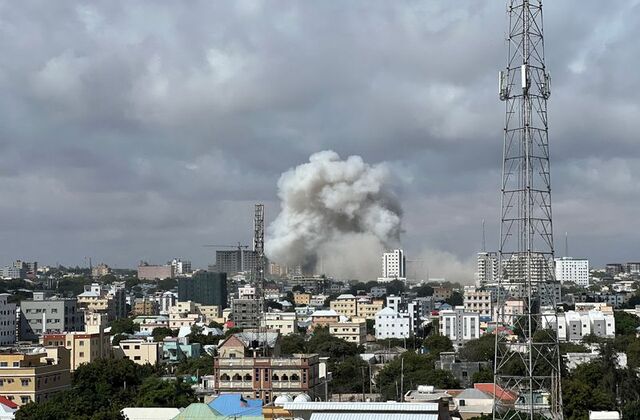
- Security situation in the capital Mogadishu remains fluid. In the recent notable attack, Five Al-Shabaab gunmen and one suicide bomber disguised as Somali soldiers targeted the mayor’s headquarters in a siege in Hamar Weyne district of Mogadishu on January 22.
- Al-Shabaab conducted a complex suicide raid targeting a US-trained Danab forces base in Gal’ad, El Dheere district, Galgudud region, north-central Somalia, on January 20. The attack killed the deputy commander of the Danab forces. Al-Shabaab also looted/seized large cache of assorted weapons. This is becoming a common practice by Al-Shabaab after attacks on FOBs.
- Notable CT operations in near Dhagahow, Bal’ad district, Middle Shabelle, south-central Somalia, on January 19 by Somali government and local militia forces cleared an Al-Shabaab gathering.
- The U.S. military reported that 30 Al-Shabab fighters were killed in a “collective self-defense strike” against Al-Shabab near Galcad on January 20. U.S. Africa Command, or AFRICOM, said the strike followed Al-Shabaab’s attack on Somali government forces in Galcad.
- Local militia preemptively attacked an Al-Shabaab gathering near Beer Haano, Beledweyne district, Hiran region, central Somalia, on January 19. Reinforcements from Beledweyne joined the fighting.
Economic Outlook: __________________________
- Despite insecurities brought forth by terrorists, Al-Shabaab and ISIS Somalia, Somalia people continue to struggle to survive. Engaging in businesses especially in the capital Mogadishu where they still extorted for taxes by Al-Shabaab. Herders also struggling citing the effects of drought witnessed in nearly all parts of the country.
- Notable Inflation is affecting the ability of pastoralists, agropastoral and farmers to afford basic food items and livelihood inputs. The economic impact on farming and pastoral livelihoods is having a knock-on effect for other economic activities, which depend on their trade.
- Sixth failed rainy season spells further disaster and loss of life in Somalia. At least 8.3 million people in Somalia are on the brink of catastrophic famine as aid agencies fail to secure sufficient funding required to avert the crisis.
- However, optimism still shines through despite Somalia’s woes. For example, Friday is beach day in Mogadishu. Early in the day before Friday prayers and before the sun gets too hot, people flock to Liido Beach on the eastern side of the city.
- Families sit under cloth awnings on the beach and drink tea. Young men play soccer barefoot on the sand. Teenagers record Tik-Tok videos of each other on their phones. People wade out into the sandy shallow waters of the Indian Ocean.
- Oil exploration is another boom for Somalia. The semi-autonomous region of Somaliland defended its right to award oil exploration licenses, after Somalia’s government declared Genel Energy Plc’s operations there illegal. Genel Energy expects an expenditure of up to $25 million in Somaliland in 2023.
Socio-Political Outlook: ___________________________
- The economic, environmental, political and social contexts at the local, national and regional levels are continually evolving, and regional to global events such as the economic repercussions of Covid-19 are being felt at the local level.
- Although humanitarian assistance has helped to delay an official famine declaration in Somalia, the International Rescue Committee warns the thresholds for famine are likely to be met in April-June 2023 as current funding levels are dropping and bearing in mind humanitarian challenges perpetrated by Al-Shabaab in the areas largely under their control.
- There are two main forces responsible for the catastrophe that is Somalia. The dominant faction of the Somali political class is the chief culprit. Their agenda has been to attain power and loot the country’s resources for private gain.
- Second, the international community, who are the junior partners of the political class. Based on my observations, representatives of western and African governments fear that Somalia could become a base for “terrorists”, which might destabilise the strategic Horn of Africa. But they are unwilling to engage with civic and independent-minded Somalis.
- It’s likely that the terrorist group will be defeated one day. But there are no signs that the political elite is willing or capable of changing, short of a radical shift in international pressure or a determined public, unfortunately the tragedy might fester for decades, with or without Al-Shabaab due to political interests.


