

Executive Summary
July 2025 marked an escalation in Islamic State operations across Mozambique, Somalia, and the DRC, with a clear emphasis on civilian-targeted violence and information dominance. Mozambique’s insurgency advanced further south into Chiúre and Ancuabe districts, challenging the geographic containment strategy and highlighting persistent gaps in rapid response and inter-force coordination. In the DRC, ISCAP’s intensified massacres and disruption of education reflect a deliberate destabilization campaign aimed at eroding governance and deepening sectarian fault lines. Somalia’s ISS faction remained resilient in Bari region despite severe leadership attrition, while evidence of cross-border infiltration into Ethiopia underscores the faction’s broader regional aspirations.
MOZAMBIQUE
- 30th July- Islamic State Mozambique (ISM) militants led an armed assault against Christians in Cinco area in Chiure district.
- 29th July- ISM militants captured and executed a civilian in Chiure district.
- 28th July– ISM militants led am armed assault on Mozambican Militia forces in Walicha area in Chiure district; an attack that left several people killed.
- 27th July- ISM militants captured and executed a Christian in Kamila, Chiure District.
- 25th July– ISM militants detonated an IED on Mozambican Army Forces Between Nacutucu and Nambija, Macomia District.
- 26th July- ISM militants captured and executed two Christians in Napala area in Chiure district.
- 24th July- ISM Militants conducted an armed assault on Christians in Ntonhane in Chiure district.
- 24th July- ISM militants led an armed assault against the Police, they freed a prisoner and seized weaponry from them in Chiure Velho area in Chiure district.
- 23rd July– several people were injured after ISM militants led an armed assault on Christians and Militia Forces in Magaia, Muidumbe District.
- 20th July– Several homes were attacked and raided by ISM militants who conducted the attack in Nannduli area in Ancuabe District.
- 22nd July– Armed ISM militants captured and executed six Christians in Natuqua, Ancuabe District, Cabo Delgado.
- 15th July- a group of approximately 60 fighters was seen moving across the road that links Macomia town to the coast signaling a significant migration by the terror group.
- 03rd July- ISM terrorists conducted an armed attack on Mozambican troops in Quiterajo area of Macomia, casualties were reported on both sides.
SOMALIA
- 31ST July- Ethiopian authorities arrested at least 82 terror suspects who are accused of supporting the Puntland-Based Islamic State Somalia (ISS) group across the country.
- 14th July- ISS terrorists conducted an armed assault against the Puntland Defense Forces in Daray-Madobe, Jalil Valley in Bari region; they claimed killing 16 soldiers, wounding over 20.
- 13th July- ISS militants ambushed Puntland Forces in Geeso-Qabad in Bari region.
- 08th July- ISS militants led an armed assault against the Puntland Forces in Tuur Masale, Jalil valley in Bari.
- 05th July- ISS detonated an IED on a Puntland Forces Patrol in Tuur Masale, Jalil valley in Bari
- 04th July– ISS terrorists detonated an IED on a Puntland Forces Patrol in Dhasaq, Jalil Valley in Bari.
- 02nd July- ISS militants led an armed attack against Puntland Forces Patrol in Tuur Masale, Jalil Valley.

D.R. CONGO
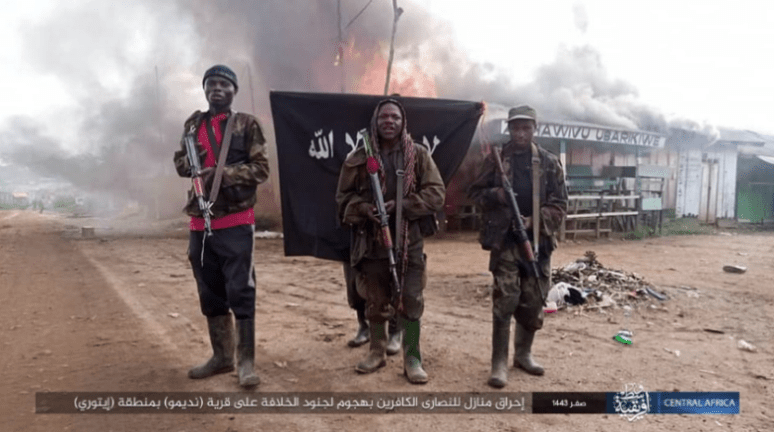
- 27th July- Islamic State Central Africa (ISCAP) militants led an armed assault on Christians, killing about 45, in Komanda, Ituri Province.
- 27TH July- ISCAP Terrorists led an armed assault against civilian population in Idohu area in Ituri Province.
- 26th July- Several people were injured after ISCAP militants mounted an armed attack against the Congolese troops and Christians in Mohoyo area in Ituri province.
- 20th July- ISCAP militants captured and executed two Christians on the RN4 Between Komanda and Eringeti, Ituri Province.
- 17th July- ISCAP militants captured and executed 7 Christians in Ofaye Otto Maber area in Ituri Province.
- 16th July- ISCAP terrorists captured and killed two Christians in Mambelenga area of Ituri province.
- 16th July- ISCAP terrorists captured and killed one person in Biou area of Ituri province.
- 13th July- ISCAP terrorists captured and executed one person in Ofaye Otto Maber area of Ituri province.
- 11th July– ISCAP militants conducted an armed assault on several Christians in Ofaye Otto Maber area of Ituri province.
- 11th July- ISCAP terrorists captured and killed six near Ofaye Otto Maber area of Ituri province.
- 11th July ISCAP militants conducted an armed attack against Christians in Mambomi area in Ituri.
- 10th July- Several people were injured after an armed assault on Christians in Kateri area in Ituri Province.
- 09th July- ISCAP militants led an armed assault on Christians in Samboko, Ituri Province.
- 03rd July– Congolese Army forces were attacked by ISCAP militants on Bango area in Ituri Province.
ANALYSIS AND INSIGHTS
MOZAMBIQUE
In July 2025, Islamic State Mozambique (ISM) reinforced its status as a dynamic insurgent force with growing operational depth across Cabo Delgado. Building on patterns observed in previous months, ISM continued to maneuver between districts, stretch state capacity, and exploit gaps in local defense. The group’s ability to maintain pressure in the north while pushing southward into Chiúre and Ancuabe districts reflects a level of coordination that Mozambique’s security forces have yet to match.
The southern advance into Chiúre, which displaced tens of thousands, was not simply a reaction to military pressure further north. Rather, it was a calculated demonstration of reach, one that challenged assumptions about the geographic limits of ISM’s activity. Crucially, the group’s presence in Chiúre lasted more than a week before reinforcements arrived. That delay speaks to a persistent issue identified in previous briefings: the Mozambican state continues to struggle with rapid response and force mobility in rural areas. The fact that the incursion happened within 50 kilometers of both Mozambican and Rwandan military positions only reinforces concerns about command and coordination at the provincial level.
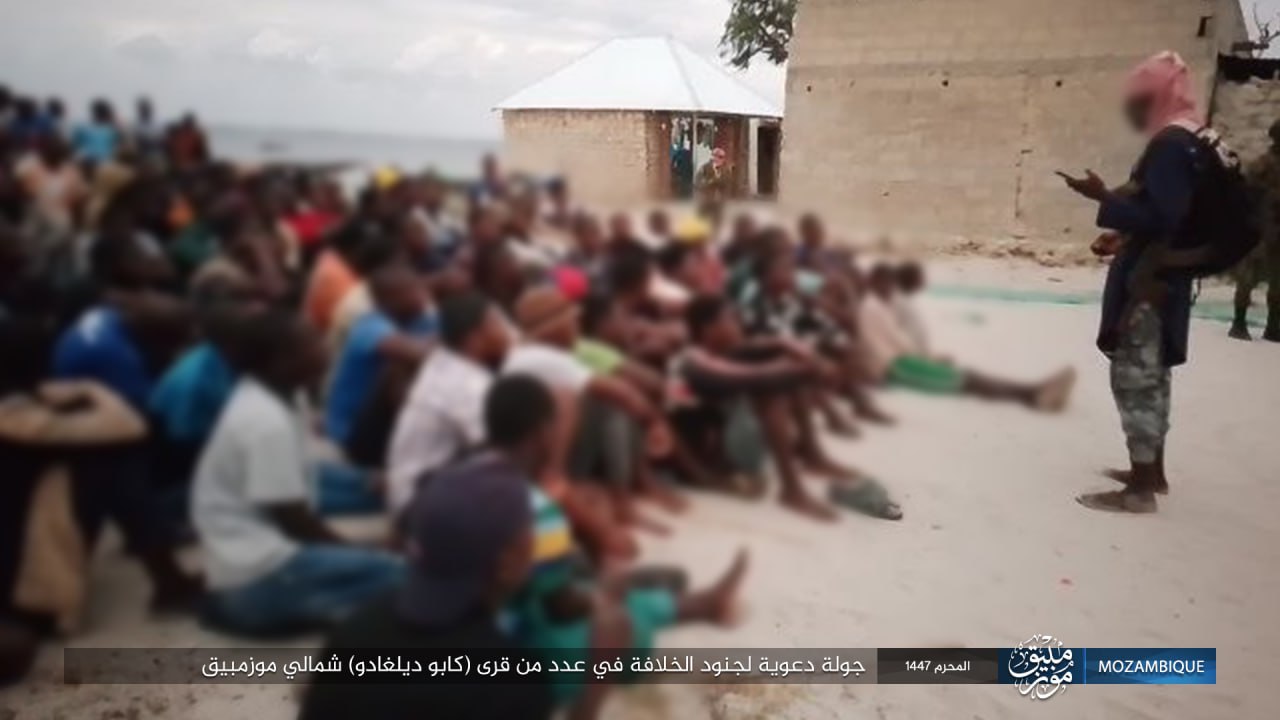
ISM’s strategy this month was marked by a deliberate contrast in posture. In predominantly Muslim districts, the group relied on intimidation and religious messaging. In Christian-majority areas, it employed targeted violence and destruction. This pattern, seen before but now amplified, is increasingly central to ISM’s propaganda output. The group’s media wing, under the direction of Suleimani Nguvu, capitalized on these events to dominate the online narrative, releasing a steady stream of claims, images, and video footage intended to project control and inspire fear. In the broader information space, ISM remains ahead of the state.
While attacks continued in the north, particularly along the coast and in inland strongholds, ISM also maintained economic pressure through roadblocks, most notably on the N380 highway. These checkpoints are more than financial operations; they serve as instruments of governance in ungoverned zones. The extortion of civilians and the disruption of trade routes signal a long-term strategy to erode confidence in the state’s presence and force engagement on insurgent terms. In response, local business groups have begun exerting pressure on provincial authorities, leading to the reintroduction of military escorts. This reactive posture, however, does little to address the root of the insecurity.
Political developments in Maputo continued to intersect with the conflict zone. President Chapo’s recent military reshuffle, including key appointments within the FADM, suggests an attempt to reframe the counterinsurgency effort. Yet July’s events point to an unchanged reality on the ground. The state’s defensive posture remains slow and fragmented, and its reliance on external forces; Rwandan troops in particular remains central. Though payments to Rwanda have resumed, financial uncertainty around their continued deployment lingers, raising strategic questions about sustainability.
Regional cooperation, including the newly signed Mozambique–Malawi agreement, offers some promise. However, given ISM’s demonstrated cross-border links and access to regional recruitment channels, such agreements will only be effective if they are implemented with urgency and backed by actionable intelligence sharing.
Looking ahead, several dynamics warrant close monitoring. The insurgents’ attempted movement across the Lúrio River into Nampula, though reportedly unsuccessful, signals future intent. Their ability to simultaneously operate in multiple districts, target civilians, disrupt economic activity, and dominate the information space represents a comprehensive threat model. Unless Mozambique and its partners pivot to a strategy that is not only reactive but preventive and adaptive, the coming months will likely see ISM continue to expand its influence both territorially and psychologically. The conflict has extended beyond the northern margins of the province, advancing both in territory and in narrative. For now, the state remains a step behind.
D.R CONGO
The July 2025 surge in violence by Islamic State Central Africa Province (ISCAP) in Ituri and North Kivu underscores a dramatic deterioration in the security environment and reveals the structural limitations of current military and intelligence efforts in eastern DRC. Throughout the month, ISCAP conducted a series of highly coordinated and ruthless attacks targeting Christian civilians, killing over 80 people in brutal assaults that spanned key zones like Komanda, Ofaye Otto Maber, and Mohoyo. From a counterterrorism standpoint, this pattern of violence reflects a deliberate operational shift toward civilian-targeted mass killings aimed at asserting control, inciting sectarian divisions, and undermining state authority. The group’s ability to execute near-daily attacks over a sustained period highlights their tactical mobility, decentralized command structure, and access to weapons; many of which, as the UN Group of Experts confirms, originate from FARDC stockpiles. This indicates critical vulnerabilities in the security forces’ armory management and battlefield discipline, facilitating a replenishment pipeline for ISCAP through raids and seizures.
From an operational lens, the failure of the FARDC-UPDF joint operation “Shujaa” to neutralize ISCAP’s threat is emblematic of a broader strategic miscalculation. While the campaign achieved notable leadership decapitations, it did not dismantle the insurgency’s grassroots infrastructure or interdict its core logistical corridors between Beni, Lubero, and Irumu. Instead, ISCAP exploited the vacuum left by FARDC forces diverted to counter M23 offensives, intensifying attacks in peripheral zones like northwest Lubero and southern Ituri. The insurgents have capitalized on fragmented terrain and inter-group competition, notably clashing with local militias such as the FPP/AP, to consolidate territorial footholds. Simultaneous attacks, often designed to overload local security responses, point to a sophisticated understanding of operational tempo and state capacity thresholds. Moreover, the group’s leader, Ahmad Mahmood Hassan alias Abwakasi, appears to maintain a direct operational link with Daesh central command, as evidenced by coordinated media claims and ideological alignment, reinforcing ISCAP’s role as a regional node within a global jihadist framework.
The intensification of activities by the Islamic State Central Africa Province (ISCAP) in Ituri and North Kivu has had devastating consequences on civilian infrastructure, especially in the education sector. ISCAP’s operational approach increasingly targets civilian-populated areas such as schools and health centers in an effort to undermine state authority, disrupt local resilience, and instill widespread psychological fear. More than 5,000 students in areas like the Mwenye group have been displaced, and 2,594 schools across the eastern provinces are now non-operational. These outcomes are not incidental. ISCAP is employing asymmetric tactics designed to erode both local governance and long-term social cohesion by disrupting access to education and weakening the next generation’s prospects. This strategy also aims to exploit humanitarian vacuums, allowing radical narratives and recruitment to take root. The insecurity caused by ISCAP-related violence must be viewed as a deliberate destabilization campaign rather than collateral damage, and it demands an urgent reassessment of both military operations and community-based counter-extremism strategies.
Looking ahead, the resurgence of legacy warlords like Thomas Lubanga and Innocent Kaina, now leading new armed movements in Ituri, threatens to further complicate the counterterrorism landscape. These actors are leveraging historic grievances and power vacuums to rebuild militant patronage networks, potentially creating new pipelines for radicalization and logistical collaboration with groups like ISCAP. Despite peace agreements such as the Aru II Accords, intercommunal tensions remain high and reintegration initiatives uneven, making communities susceptible to recruitment by armed groups. The July escalation should serve as a wake-up call to regional actors and international partners: military responses must be coupled with granular intelligence-led targeting, community engagement strategies, and security sector reforms to prevent FARDC’s own assets from fueling the very insurgency they are mandated to suppress. Without a recalibrated and multidimensional counterterrorism strategy, ISCAP will continue to exploit the fractures of the eastern Congo to sustain and expand its operational presence.
SOMALIA
In July 2025, Islamic State Somalia (ISS) maintained a concentrated operational focus in Puntland’s Bari region, conducting a series of armed assaults and IED attacks against Puntland Defense Forces in the Jalil Valley area. These incidents, which spanned from early to mid-July, demonstrate the group’s tactical persistence despite sustained military pressure. Ethiopian authorities reported the arrest of 82 suspected ISS operatives accused of supporting the faction and attempting to establish sleeper cells within Ethiopia. This highlights the group’s ongoing cross-border infiltration strategy and its wider regional ambitions. With an estimated 700 to 1,500 fighters, ISS remains considerably smaller than Al-Shabaab but has benefited from foreign fighter inflows, diversified revenue streams, and integration into the broader Islamic State global network.
Puntland’s Operation Hilaac, which entered its fourth phase in July, has inflicted severe leadership losses on ISS, eliminating nearly 85 percent of its command structure since its launch in December 2024. The deaths of key figures from multiple nationalities underscore the group’s international composition and the strategic blow dealt to its operational capacity. The operation has cleared a 420-kilometre stretch of mountainous terrain, significantly restricting ISS mobility and sanctuary options. Phase 4 aims to neutralize remaining fugitives, while the planned Operation Onkod will target Al-Shabaab strongholds, signaling an intent to decisively reconfigure the militant landscape in northeastern Somalia. The capture of a Turkish fighter further reinforces ISS’s transnational connections and the importance of sustained counter-terrorism cooperation between Puntland, Ethiopia, and international partners.
CONCLUSION
The month’s developments confirm that Islamic State affiliates in East and Central Africa are sustaining operational adaptability, exploiting state weaknesses, and maintaining strategic coherence across dispersed theaters. ISM in Mozambique demonstrated the capacity to challenge state forces close to allied military positions, eroding public confidence in provincial defense structures. In the DRC, ISCAP leveraged a high-tempo campaign of mass killings, infrastructure destruction, and psychological warfare to solidify its grip in contested zones while benefiting from security force deficiencies and arms leakage. ISS in Somalia, though under military pressure, sustained its operational tempo through targeted strikes and continued to project influence beyond Puntland’s borders. The convergence of territorial ambition, cross-border mobility, and media exploitation points to an increasingly interconnected jihadist threat ecosystem that will remain difficult to contain without synchronized regional and international countermeasures.
Addressing this threat requires a decisive pivot from reactive postures to proactive disruption. Embedding mobile rapid-response units with integrated intelligence teams in high-risk zones would enable states to intercept insurgent plans before they are executed. This must be complemented by a deeper commitment to regional intelligence fusion, ensuring that Mozambique, Somalia, the DRC, and their neighbors share timely information on cross-border fighter movements, financial flows, and media operations. Only through pre-emptive action and coordinated intelligence can security forces degrade the operational and propaganda capabilities that sustain the insurgents’ momentum.


