

Executive Summary
In May 2025, Islamic State-affiliated insurgencies in East and Central Africa demonstrated increasing operational tempo, lethality, and strategic adaptability. In Mozambique, ISM launched coordinated high-casualty attacks against Mozambican and allied forces, while expanding its footprint into Niassa Province and the maritime domain, including a nearshore attack on a Russian research vessel. In the Democratic Republic of Congo, ISCAP intensified sectarian violence in North Kivu and Ituri provinces, executing Christian civilians and targeting local militias, while capitalizing on the M23 crisis to expand its reach. In Somalia, despite territorial losses, ISS maintained steady insurgent operations in Puntland, bolstered by effective propaganda and regional linkages. Collectively, these developments reflect a cross-border insurgent resurgence underpinned by exploitation of state fragility, ungoverned spaces, and regional coordination gaps.
MOZAMBIQUE
- 27th May- ISM militants led an armed assault on Mozambican Army Forces in Congresso, Macomia District, Cabo Delgado; at least 10 soldiers were killed.
- 27th May- a food truck was ambushed and looted by armed men, presumed to be insurgents, near the village of Mungwe on the N380 highway in Muidumbe.
- 24th May- insurgents looted the village of Marere in MDP mainly stealing food.
- 20th May– insurgents appeared in the village of Makulo where they screened sermons by the late Kenyan extremist preacher Sheikh Aboud Rogo and demanded money.
- 13th May- ISM terrorists attacked Mozambican troops killing one and injuring at least three of them in Macalange area in Meculo District in Niassa Province.
- 12th May– ISM insurgents kidnapped at least seven people in the village of Macalange, about 20 km north of Mecula town in Niassa, and demanded that locals cook for them.
- 11th May- ISM insurgents near the village of Magaia in Muidumbe kidnapped six girls and two boys—later killing the boys, while one girl escaped and five remain missing.
- 10th May- Suspected ISM militants shot at Russian Survey vessel outside of Tambuzi Island.
- 10th May- The Russian hydrographic survey ship Atlantida, on a scientific mission with Mozambique’s National Institute of Oceanography, came under fire from insurgents near Tambuzi Island in MDP but escaped unharmed after signaling distress.
- 10th May- several houses were raided and looted by ISM militants who attacked and terrorized Macomia Town.
- 09th May- ISM militants led an armed assault on Mozambican Army Forces in Dimayo, Muidumbe District.
- 08TH May- Insurgents in Muidumbe district, Cabo Delgado, launched their deadliest attack of the year, killing 11 soldiers and seizing a large cache of weapons.
- 03rd May- three Rwandan troops were injured after ISM militants launched an armed assault against their position on N380 in Ntotwe in Mocímboa da Praia District (MDP).
THE DEMOCRATIC REPUBLIC OF CONGO
- 21ST May- ISCAP militants led an armed assault on Wazalendo Forces in Manguso, Lubero District, North-Kivu Province.
- 20TH May- several military personnel were injured in an armed assault conducted by ISCAP militants in Kasiro area of Lubero District in North Kivu Province.
- 17th May- ISCAP militants led an armed assault on Congolese Militia Forces and Christians in Massakoke, Lubero Region.
- 16th May- ISCAP militants led an armed assault on Congolese Militia Forces in Ombole, North-Kivu Province.
- 16th May- ISCAP militants captured and executed a Christian in Ngerega, Ituri Province.
- 16TH May- ISCAP Terrorists captured and executed four Christians in Matuna, Lubero District, North-Kivu Province.
- 08th May– Suspected ISCAP terrorists led an armed assault against civilians killing at least 13 people in Muponda area in Lubero district, North Kivu.
- 08th May- ISCAP militants led an armed assault on Wazalendo Forces in Musiola, Lubero District, North-Kivu Province.
- 07th May- ISCAP militants conducted an armed assault on Christians population in Mabambi area of Lubero District, North-Kivu Province.
- 05th May- three Christians were captured and beheaded by ISCAP terrorists in Maiba area of Lubero.
- 02nd May- one Christian was captured and beheaded by ISCAP terrorists in Maiba area of Lubero.
- 03rd May- A group of Christians was ambushed by ISCAP terrorists leading to the death or injury of several of them in Maiba area of Lubero district.
SOMALIA
- 21ST May- Islamic State Somalia (ISS) militants led an armed assault on Puntland Defense Forces in Dhasaan area in Jalil Valley in Bari region of Puntland.
- 17th May– ISS militants led an armed assault on Puntland Defense Forces in El Arare Valley, Puntland.
- 15th May– ISS militants detonated an IED on Puntland Defense forces in Daray-Madobe in Jalil Valley in Puntland.
- 12th May- Puntland Defense Force were ambushed by ISS militants in Daray-Madobe in Jalil Valley in Puntland.
- 14th May- ISS terrorists clashed with Puntland forces in Guriasamo in Bari region.
- 11th May- several Puntland troops were injured after an IED was detonated by ISS on their positions in Puntland.
- 10th May- ISS militants targeted a Puntland forces vehicle with an improvised explosive device (IED) in Daray-Madobe, Bari Region, Puntland.
- 03rd May– five suspected ISS militants conduct a suicide attack targeting Puntland forces base in Dhasaan Village, Puntland.
- 02nd May- ISS terrorists targeted a Puntland forces vehicle with an improvised explosive device (IED) in Daray-Madobe, Bari Region, Puntland.
ANALYSIS AND INSIGHTS
MOZAMBIQUE
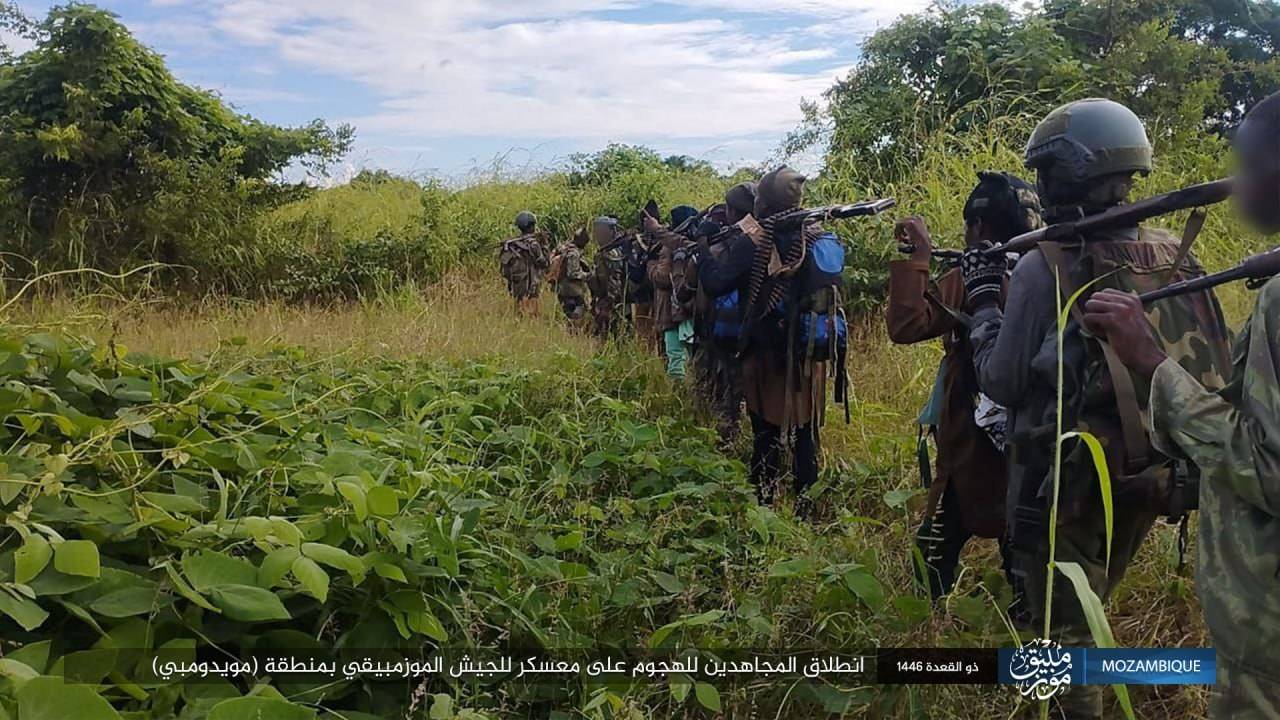
The security situation in Mozambique, particularly in Cabo Delgado and parts of Niassa Province, has significantly deteriorated throughout May, marked by a surge in coordinated and geographically dispersed attacks by Islamic State Mozambique (ISM). The group has demonstrated growing operational capability, targeting military forces with deadly ambushes in Congresso, Dimayo, and Primeiro de Maio, killing at least 22 soldiers, including Rwandan allies, and seizing weapons. Simultaneously, ISM continues to terrorize civilians through kidnappings, food looting, and psychological operations such as airing extremist propaganda in villages like Makulo. The targeting of infrastructure, including food trucks and even a Russian scientific vessel, reveals a strategic intent to disrupt state logistics and international interests. The lack of effective response by Mozambican and allied forces, coupled with ISM’s reach into previously calmer areas like Niassa, suggests worsening state control, poor inter-force coordination, and a widening insurgent threat that increasingly undermines both civilian safety and military stability across northern Mozambique.
The escalating attacks by ISM on Mozambican Armed Defense Forces (FADM) positions, most notably the recent assaults on bases at Primeiro de Maio and Namabo which claimed at least 21 lives, underscore a growing security crisis in Cabo Delgado and expose critical weaknesses in state military strategy. These high-casualty operations, occurring near the heavily militarized N380 corridor, highlight ISM’s persistent operational capability and its ability to exploit lapses in coordination between FADM and Rwandan forces. The apparent absence of a robust or timely military response to these incidents reinforces a troubling pattern of inertia that has emerged since late 2024, eroding public confidence in state and allied forces. FADM’s mounting casualties are likely damaging morale and diminishing combat effectiveness, while Rwandan forces, despite their success in areas like Palma, may struggle to maintain local legitimacy in Macomia, especially among displaced populations who perceive their prolonged displacement as a consequence of military failure. The continued ISM presence in Macomia district is not only a tactical threat but also a strategic and political liability, exposing fractures in joint force cooperation and creating openings for insurgent propaganda to gain traction among vulnerable communities.
The attack on the Atlantida underscores the ISM’s evolving maritime capabilities and strategic intent, marking a shift from opportunistic looting toward more complex nearshore operations. The surge in maritime incidents, rising from three in 2023 to 23 in 2024 and already 12 in 2025, demonstrates both increased insurgent activity and persistent gaps in coastal security, particularly off Mocímboa da Praia despite the presence of high-speed patrol boats and Rwandan forces. The ambiguity surrounding the attackers’ vessels, possibly repurposed local fishing boats including those donated by TotalEnergies, points to ISM’s adaptability and use of civilian assets for concealment. This trend poses a growing threat to commercial shipping and offshore energy infrastructure, especially as maritime traffic supporting the LNG sector increases. Furthermore, the murky circumstances around the Atlantida’s presence in a high-risk zone and its affiliation with Russian scientific programs invite speculation about dual-use operations, raising broader geopolitical concerns about foreign intelligence activities amid Cabo Delgado’s security vacuum.
THE DEMOCRATIC REPUBLIC OF CONGO
The security situation in the Democratic Republic of Congo (DRC), particularly in North Kivu and Ituri provinces, remains dire and continues to deteriorate as Islamic State Central Africa Province (ISCAP) intensifies its campaign of violence. Throughout May, ISCAP militants launched a series of coordinated assaults against military forces such as the Wazalendo and Congolese militia groups, while also systematically targeting Christian civilians through executions, beheadings, and village raids. Lubero District has emerged as a primary hotspot, with a staggering concentration of attacks including massacres in Maiba, Mabambi, and Muponda, reflecting a pattern of religiously motivated violence that exacerbates communal tensions. The group’s operational reach across both North Kivu and Ituri, as evidenced by incidents in Ngerega and Matuna, suggests a growing strategic footprint and an emboldened presence despite regional military operations.
Compounding this crisis is the continued activity of the M23 rebel group, whose resurgence has further destabilized the eastern DRC and diverted military focus away from countering ISCAP. M23’s offensives have displaced thousands, strained humanitarian resources, and undermined efforts to establish security governance, allowing ISCAP to exploit ungoverned spaces and weakened local defense structures. The simultaneous threats posed by M23 and ISCAP have overwhelmed Congolese security forces, created overlapping zones of insecurity, and fostered an environment where civilian populations face routine massacres, abductions, and displacement. This convergence of armed threats has not only deepened the humanitarian emergency but also highlights the urgent need for a more unified and adequately resourced regional security response.
SOMALIA
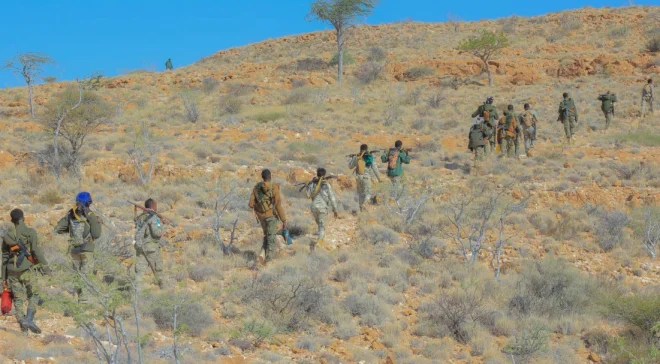
Islamic State Somalia (ISS) remains a potent and adaptive insurgent force despite sustained territorial losses and leadership decapitations inflicted by a coordinated US, UAE, and Puntland offensive in the Cal Miskaad mountains. While pushed into a defensive posture, ISS continues to conduct lethal guerrilla attacks and sophisticated suicide operations, leveraging propaganda—particularly through the emerging Manjaniq Media outlet—to project strength, discredit Puntland’s military gains, and portray tactical retreats as strategic resilience. ISS also actively exploits clan dynamics and local grievances, targeting the Puntland administration and its foreign allies in a bid to fracture support for the counterinsurgency campaign. At the same time, the group has expanded its online influence through multilingual propaganda in Somali, Amharic, and Oromo, fueling recruitment and fundraising efforts across East Africa via encrypted platforms like Telegram. These efforts, often moderated by foreign fighters and supported by hawala networks, reflect ISS’s ambition to position itself as a regional node within the broader Islamic State network, posing a sustained security and ideological threat to Somalia and its neighbors.
On 21 May 2025, a U.S. airstrike in northern Somalia killed 10 Islamic State militants, bringing the total number of IS fighters killed since President Trump’s inauguration to over 100, according to the White House. Conducted in coordination with Somalia’s federal government, these strikes target IS-Somalia, a faction that split from al-Shabaab in 2015 and operates mainly in Puntland. Despite its small size, IS-Somalia remains a persistent regional threat with ties to affiliates in Mozambique and the Democratic Republic of Congo. The group has lost several senior commanders in recent years, yet instability in Somalia continues to create conditions for its survival and potential growth. Meanwhile, the Trump administration is reportedly considering formal recognition of Somaliland, a self-declared state in northern Somalia, in exchange for basing rights for a U.S. naval facility.
CONCLUSION
The sustained escalation of Islamic State-linked violence across Mozambique, the DRC, and Somalia underscores a critical juncture in East and Central Africa’s fight against jihadist insurgencies. In Mozambique, ISM’s simultaneous inland and maritime operations expose glaring gaps in both land-based counterinsurgency and coastal surveillance, revealing the state’s weakening grip on Cabo Delgado and Niassa. In the DRC, ISCAP’s systematic atrocities, primarily targeting Christian populations, signal an evolution from opportunistic raids to ideologically driven terror with regional spillover potential—fueled by the security vacuum left by the M23 crisis. Meanwhile, ISS in Somalia, though territorially diminished, has reasserted itself through asymmetric warfare and cross-border propaganda, serving as both a local threat and a transnational connector among Islamic State affiliates in Africa.
This multi-theatre insurgency convergence; bound by ideology, communications, and tactical mimicry highlights the inadequacy of siloed national responses. A strategic recalibration is urgently needed, prioritizing regional intelligence-sharing, maritime security frameworks, and civilian protection mandates. Without coordinated international and local action, the Islamic State’s African affiliates will continue to adapt, thrive, and reshape the region’s security landscape with profound humanitarian, political, and geopolitical consequences.


